
Colleyville, TX · Garage Door Service
Garage Door Opener Repair for Colleyville Homes
Opener grinding, reversing, or dead on arrival? Colleyville's 1980s-90s housing stock and warm summers wear openers out early. We diagnose and fix the actual failure.
- Repairs & new doors
- Springs & openers
- Serving 7 nearby communities
The Symptom
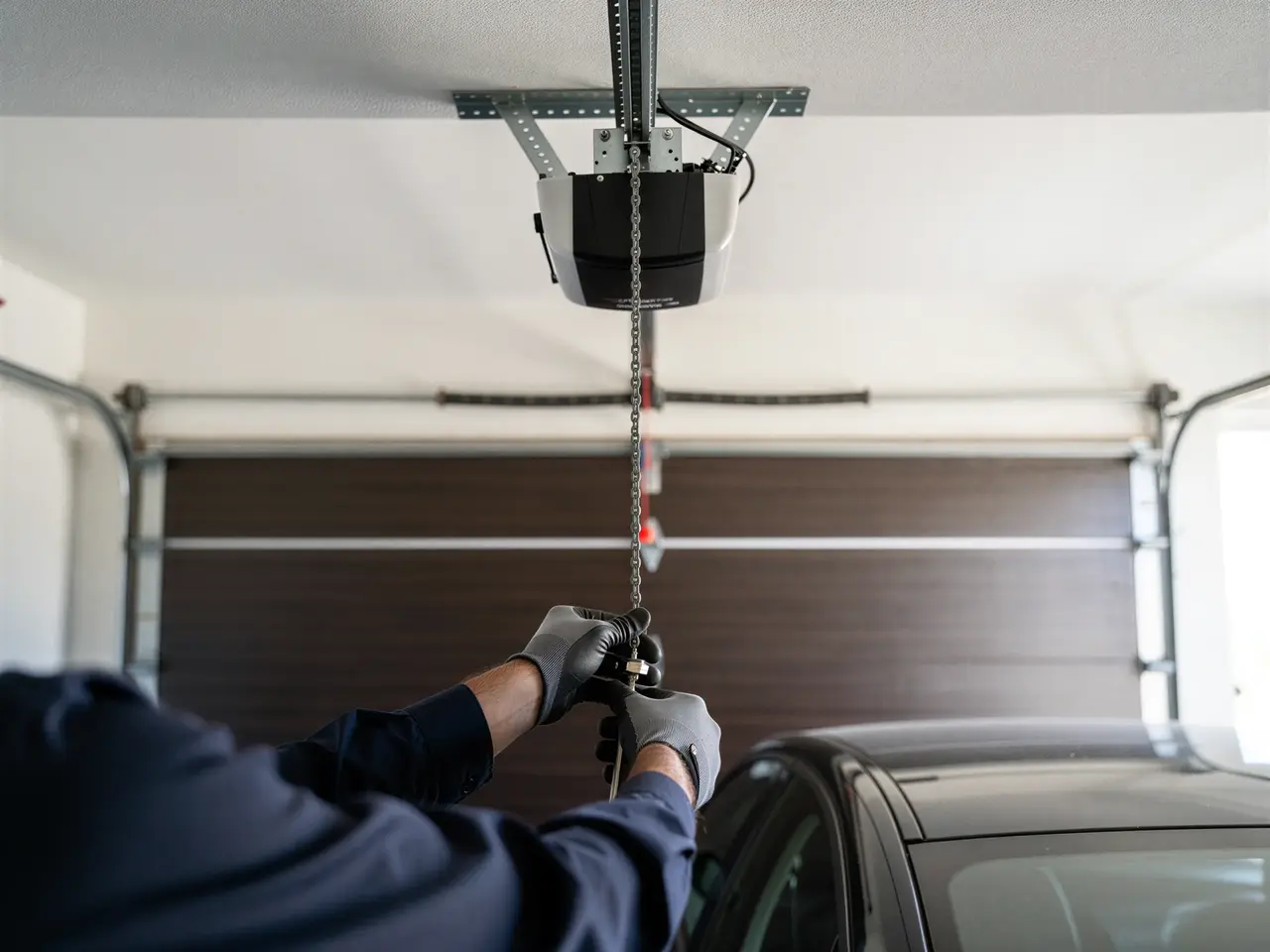
The opener hums but the door doesn't move. It runs halfway up and reverses. The remote works from the driveway but not from the street. Sometimes it's dead silent - no light, no motor, nothing when you hit the button.
These aren't random glitches. An opener that's starting to fail usually tells you which part is going before it quits completely. A door that reverses partway is almost always a sensor or travel-limit issue, not the motor. A door that's slow to respond or skips commands points to a logic board losing its grip, which happens more often once an opener has run a decade or more in a hot garage. A door that won't move at all but still has power is often a stripped gear or a capacitor that's given out.
We see all of these across the area, but the mix matters: homes built in the 1980s and 90s are now carrying openers that are original or one replacement cycle in, and that's exactly the age range where chain drives start skipping and circuit boards start failing under heat load. Knowing which symptom you've got tells us what to bring on the truck instead of guessing at the door.
Where This Job Goes Sideways
The call that starts as "opener won't work" sometimes turns into something bigger once we're in the garage. A homeowner replaces the opener logic board or even the whole unit, and the door still doesn't behave right - because the real problem was a worn roller or a spring losing tension, and the opener was just the part straining hardest to compensate.
Openers are built to lift a balanced door. If the springs are weak, the opener motor works overtime every single cycle, which burns out capacitors and strips gears years before they should wear out. Replacing the opener without checking the door's balance just restarts the clock on the same failure.
The other place this goes sideways: safety sensors. If the photo-eye sensors at the bottom of the track are misaligned by even a few degrees, some openers will run the door down and reverse it, and people assume the opener itself is broken. It's a five-minute alignment fix, not a parts replacement, but it gets missed because it looks like a motor problem from inside the house. We check door balance and sensor alignment on every opener call before we touch the unit itself.
What Causes It Around Here
Housing in this area runs from 1953 up through 2014, with the bulk of it built in the 1980s and 90s. That means a large share of garages are carrying openers that are either original to the house or on a second unit installed when the first one died of old age - and both of those bands are now well past the point where belts, gears, and capacitors are the weak link.
Heat is the other half of it. This area sits in a moderate-to-heavy heat climate band, and an attached garage with a south- or west-facing door can run considerably hotter than the outside air in summer. Opener circuit boards and capacitors are rated for a working temperature range, and a garage that regularly bakes past that range shortens their service life. It's not that the parts are cheap - it's that they're doing their job in a harsher box than the manufacturer tested for.
Put those two together - an aging housing stock and a climate that cooks the garage - and opener failure shows up here on a shorter timeline than it would in a milder climate with newer construction.
Doing It Yourself
Some of this is fair game for a homeowner. Wiping down and realigning the photo-eye sensors, checking that the wall button has power, and making sure nothing's blocking the sensor beam are all things you can do with a flashlight and ten minutes. Lubricating the chain or belt with the right lubricant is fine too.
What we don't recommend doing yourself: opening the opener housing to replace a circuit board, capacitor, or motor. These units carry line voltage, and matching the wrong board to the wrong motor assembly is a common way to turn a repairable opener into scrap. We also don't recommend troubleshooting an opener problem before checking the springs and cables - working under a door with unbalanced springs is how people get hurt, opener aside.
Here's the honest limitation: if your opener is old enough that the manufacturer no longer makes replacement boards for it, we'll tell you straight that repair isn't worth the labor, even if a part could technically be sourced. At that point a new opener costs less than chasing parts for a unit that'll fail again in a year anyway.
Frequently asked questions
Why does my garage door opener only act up in the summer?
Heat is hard on opener electronics. In this climate band, an attached garage can run well above outside temperature, and circuit boards and capacitors degrade faster once they're regularly working past their rated range. If your opener struggles or cuts out on hot afternoons, that's usually a heat-stressed board, not a coincidence.
My opener runs but the door reverses before it closes. Is that the opener?
Not usually. That behavior is almost always the safety sensors near the floor - misaligned, dirty, or blocked. Openers are designed to reverse rather than risk closing on an obstruction, so they're doing exactly what they're supposed to. Check sensor alignment first before assuming the opener itself has failed.
How old is too old for an opener repair to make sense?
It depends on whether the manufacturer still supports the unit. A lot of homes in this area have openers from the 1980s or 90s that are original to the house. Once replacement boards for a model are no longer made, repair isn't realistic even if the rest of the opener is fine - replacement is the honest answer at that point.
Can a weak spring cause opener problems?
Yes, and it's one of the most missed causes. If the springs are losing tension, the opener motor has to work harder every cycle to lift the door, which wears out gears and capacitors faster than normal use would. Replacing the opener without checking spring tension often just means the new unit fails early too.
Related services
Related guides
By Neighborhood
Opener Repair across the Colleyville area
We also handle opener repair in these Colleyville-area suburbs.
Book garage door service in Colleyville
Call now or request a quote - tell us what the door is doing and where you are.